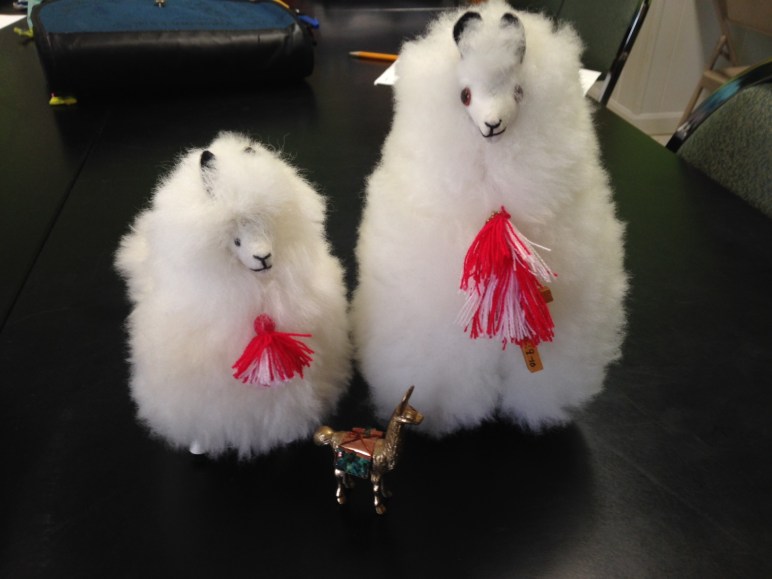
A recent student brought me back this adorable little llama from Peru. His family had an opportunity to travel during the school year and spend some relaxing time away as a family. While internally, I wanted to be traveling the world myself, I did appreciate this token that he returned with to let me know that he had been thinking of me while enjoying his time away from the classroom.
His sister also returned with llamas for her friends. This created a “llama herd” in the middle school for several weeks. This herd of llamas left me wondering about their lifestyle and behaviors. We do not have llamas in Maine, and I have very little experience with these creatures other than stories I had heard about them “spitting” at people and having a tendency to be mean.
This led me to research. What good teacher would not end up there? This is what I found.
- Llamas can be as tall as six feet.
- Llamas can weigh between 280 and 450 pounds.
- Llama stomachs have three compartments.
- Llamas are tough.

Along with being a very social animal, a llama is also known to be quite intelligent and has the ability to learn new skills with just a small amount of repetition. Llamas are often used as pack animals. This works until they are given too large of a load to carry. Once the load is more than they can handle, they refuse to work.
As always, I started to connect this new found knowledge to what I understand best. In this case, I recognized significant similarities between these llamas and my classroom full of students.
My students, like the llama, are very social. They like to travel in herds. They like to interact with others of their kind. My students are also very smart and when taught well can learn new skills amazingly fast. The most interesting comparison that I was able to make was how, like the llama, an overwhelmed student will come to a point that they simply refuse to continue working. They will figuratively sit down on the ground with their pack and refuse to move. Just like we do not know the reason that a llama can sense they can not continue, I do not always understand the reaction students may offer.
While I do not always feel that lightening the load for every student is the best option, I do see the value in “readjusting” the load. How can I as the teacher reorganize the pack so that the weight is more evenly distributed? How can I accommodate the individual needs of the particular student that needs a way to be able to rise up and carry their pack once again.
As the teacher, I can also learn from the llama as well. Am I able to recognize when my pack is too much, and I should stop on my path and re-evaluate the distribution of my responsibilities? Doing more is not always the answer. Working “harder” is not the response that always gets the best results. Pushing myself beyond what I am able to carry will often end the same as it does when the llama feels overwhelmed. I will start to spit or simply lie down and refuse to move.
I would like to encourage you today to evaluate the pack you are carrying. What parts of your schedule are really time wasters that leave you ineffective and overwhelmed? What items have you placed on your plate that are not really yours to carry? What expectations have you placed on yourself that are beyond reason?
An effective teacher does not always equate a busy teacher. Determine what is most important to you and stay focused there. It might even help to write a teaching “mission statement”. What is it you want to accomplish as a teacher? What are your most important items that will always make it into the pack? What items can you let go of?
Lighten your load and join the herd! We travel better in groups.
“But Martha was distracted by all the preparations that had to be made. She came to him and asked, “Lord, don’t you care that my sister has left me to do the work by myself? Tell her to help me!-Luke 10:40-41 (NIV)
Sources:
 Teaching Beyond the Norm
I think I might be a llama based on 3 out 4 descriptions given!!
This is a great analogy…and causes me to wonder, “Do I just “pack” my students or do I equip them to carry their pack?”
Another great blog entry!!
LikeLike
Great question! I think it is important to take time to assess why we do what we do. Does it have a purpose? Does it have a goal?
LikeLike
Oh my word, this is so true! There have been many times I felt as though my “pack” was just too heavy. Fortunately I’ve gotten so much better about saying one of the shortest, most powerful sentences: “No.” Being able to say that one short sentence has freed up my time and freed me from extra responsibilities BEFORE my “pack” has gotten too heavy. There’s so much more freedom when you’re able to say that word to all the requests that come your way.
LikeLike
I think that “no” is one of the hardest things to learn to say but I agree that learning to say it is extremely important!
LikeLike